Why did I start?
There is two thing humanity can do to save ourselves from global warming. Option 1 is to support environmental sustainability, and option 2 is to escape the planet (which Elon Musk is doing). Since I can’t fly rocket to Mars as of right now, I decided to support environmental sustainability. I saw from the news that burning a single traditional candle emits about 0.15 to 2.5 kg of CO2e over its lifespan, alongside millions of invisible ultrafine soot particles and volatile organic compounds. My solution was to upcycle orange peel into sustainable candles.
P.s. before I start, I am sorry that I forgot to take a photos along the way that I couldn’t show process. Just in case you are curious, here is how to make it that you can follow in your home
Most orange peel candle use the orange peel as a base without cutting all of them and drawing out scent from it. However, I extracted orange peel scent directly from orange peel and used aging technique to embed the scent into vegetable oil, which will be ingredient for candle.
Here are materials I prepared:
- Fresh orange peels
- Vegetable oil
- Beeswax
- Cotton candle wick
- Heat-resistant container
- Double boiler
Step 1: Peel the orange
To make sure that this candle is not toxic, I had to carefully research the chemical reaction that take place when I mix multiple ingredient.
The orange peel contains two important layers.
- Flavedo (orange outer layer): rich in essential oil, especially limonene, that gives orange that smell
- Albedo (white inner layer): mostly cellulose and pectin with very little fragrance
To maximize scent, I had to remove the Albedo as much as possible.
Step 2: Dry the peel
I first cut the peel into smaller pieces (chemical & physical process happen faster when surface area is greater). Then, I dried them in microwave. Because water does not mix with oil, I have to make sure that it is completely dried. This can improve extraction and prevents mold.
Step 3: Extract the Orange Oil into Vegetable Oil
Place the dried peel in a glass jar. Add vegetable oil until the peel is fully submerged. Seal the jar. Then, I rested it in dark place for few days. Every few days, I shake the jar.
This process is called cold oil infusion (maceration).
Scientific explanation:
- Most of the scented materials in orange peel like, limonene and citral, are nonpolar, which means that they dissolve in oil, which is also nonpolar. Because of this property, oil molecule diffuse into the orange peel and chemicals in orange peel diffuses out.
Step 4: Melt Beeswax
I used double boiler to melt the Beeswax. I then heat beeswax to approximately 65–75°C and slowly melt it while mixing with spoon.
Step 5. Mix the Wax and Orange Oil
I then mixed wax and orange oil in 3:1 ratio (this is golden ratio). Then, I stirred until it is fully mixed. Beeswax is mainly composed of fatty acids and hydrocarbons. When infused vegetable oil mixes with molten beeswax, orange aroma dissolve throughout the candle and are trapped within the solid wax matrix. When candle burns, it melts the wax around the wire, giving that orange scent in the air.
Step 6. Prepare the wix
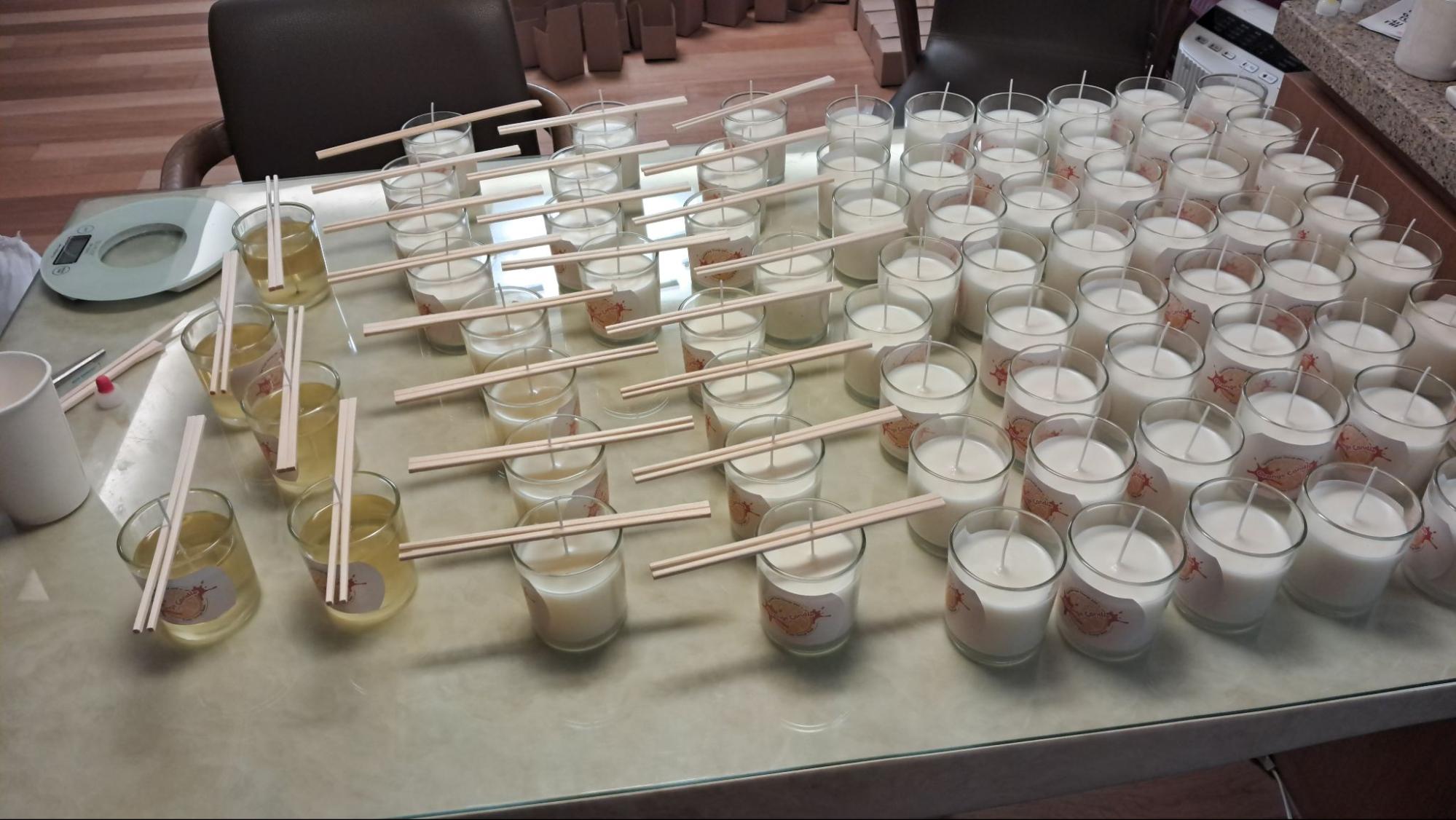
Attach cotton wicks on the container and pour in the wax+orange oil mixture into the container. Hold the wicks that way using chopsticks like the image below until the wix solidifies and lastly, trim the wicks.
Why did why use beeswax? It’s because beeswax is renewable, biodegradable, and burns longer. Some might wonder whether orange peel scent become toxic when burnt. My answer is no. Because I am using oil infusion, concentration of limonene is much lower than in concentrated essential oil. This means lower risk of irritation than conventional oil.
Sharing this candle with the rest of the world
Product and technology that doesn’t impact the world is not real product nor technology. So, I decided to donate this candles to an organization. After searching few in the internet, I found out that Baraka Library, which is not a real library but an organization that houses Muslim families in poverty, is accepting donation. Few days after I made this candle, I visited their houses and donated 100 candles. They loved it:)